






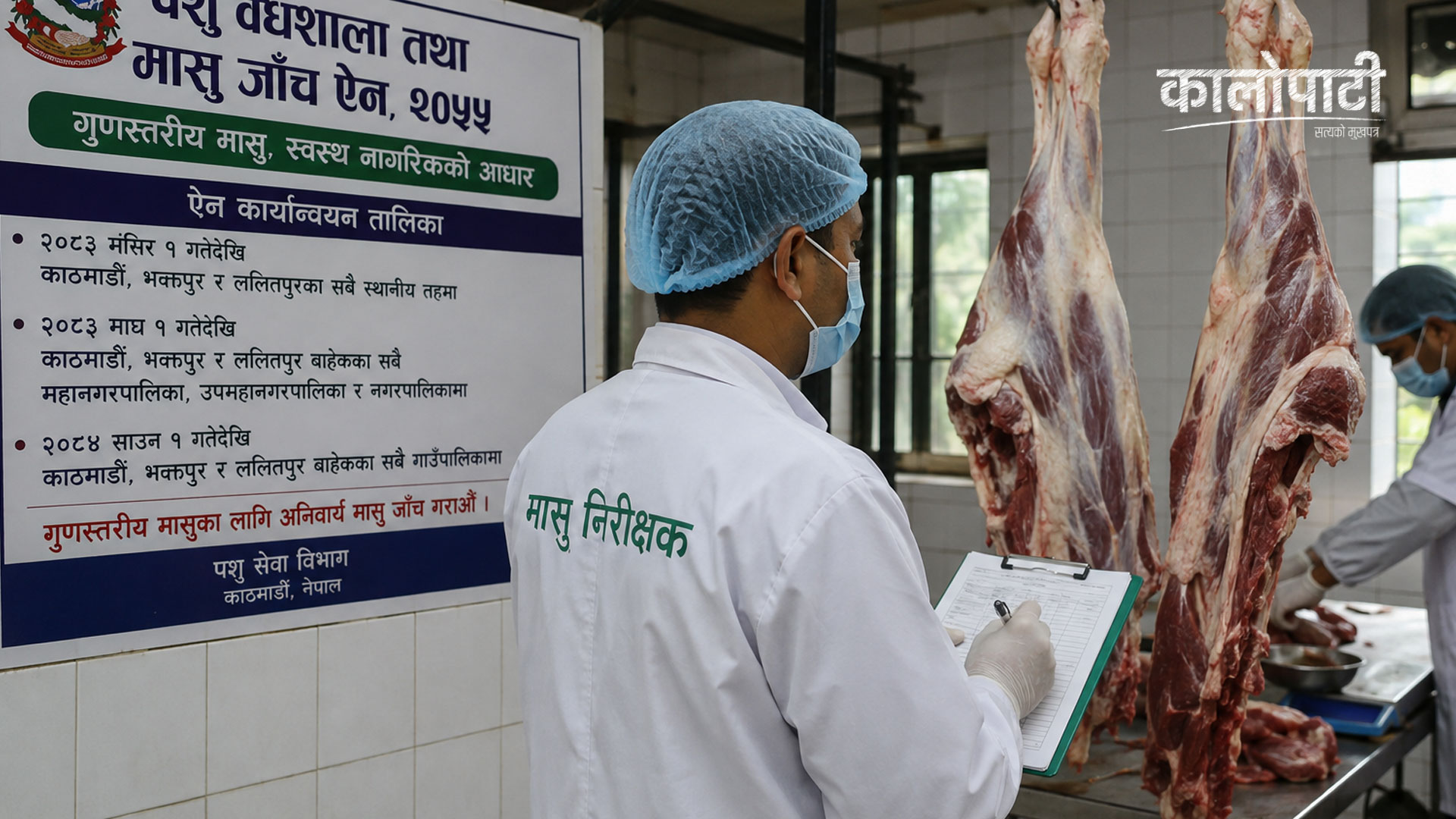

Kathmandu. KATHMANDU: The government has forwarded the process to implement the Livestock Slaughterhouse and Meat Testing Act-2055 BS throughout the country in a phased manner. The government is preparing to implement the Act across the country gradually starting from the Kathmandu Valley with an objective of providing quality and safe meat to the consumers.
Article 44 of the Constitution of Nepal has guaranteed every consumer the fundamental right to quality goods and services. The government has given priority to the implementation of the Acts based on three different mandamus orders and directive orders issued by the Supreme Court regarding the implementation of the same constitutional provision and the Act.
The Act was implemented in Hetauda in 2060, in Birendranagar of Surkhet in 2080 and in Butwal in 2081. Now, preparations have been made to expand it from a limited area and implement it throughout the country.
The Government of Nepal published a notice in the Nepal Gazette on August 17, 2083 and fixed the deadline for the implementation of the Act. The Act will be implemented in all local levels of Kathmandu, Bhaktapur and Lalitpur from November 15, 2083.
Similarly, the Act will be implemented in all metropolitan cities, sub-metropolitan cities and municipalities except Kathmandu, Bhaktapur and Lalitpur from Magh 1, 2083. A decision has been made to implement the Act in all rural municipalities except Kathmandu, Bhaktapur and Lalitpur from 1st July, 2084.
An action plan has been prepared by dividing responsibilities among the federal, provincial and local levels to make the implementation of the Act effective. Vice-Chairman of Nepal Veterinary Council, Manoj Kumar Shahi, said that the implementation action plan along with the allocation of works to be carried out by the federal, provincial and local levels was prepared and sent to the bodies concerned on August 4, 2083.
According to him, a meeting of the thematic committee comprising the provincial ministers, chiefs and representatives of the local levels had decided to implement the Act within a year.
Likewise, a meeting held on July 9, 2083 under the chairmanship of the minister with the chiefs and representatives of the local levels of the province and the Kathmandu Valley had decided to implement the Act across the country in a phased manner.
A letter was also sent on May 4, 2008 urging the local level and the province to give priority to the budget and programs for the implementation of the Act. The Veterinary Quality and Drug Regulation Laboratory has been designated as the focal office to coordinate the work related to meat testing and inspection.
According to Shahi, the government has also intensified discussions with meat entrepreneurs and other stakeholders before implementing the project. On August 17, 2083, a discussion was held with the central president of Khadki Society and presidents of meat entrepreneurs association of three districts of Kathmandu Valley. On the occasion, businessmen welcomed the implementation of the Act. On the same day, discussions were held with poultry and meat entrepreneurs.
So far, around 840 veterinarians have applied for the post of meat inspector. The process of conducting the training has been forwarded by revising the curriculum of meat inspector training.
Similarly, the local governments have been mapping the slaughterhouses, slaughter places and meat shops. In the case of Kathmandu Valley, the state office has reviewed the matter on August 20.
The government is also collecting details of industries that can use bone, blood, skin, internal organs, hooves and horns and other by-products in addition to the meat produced from the slaughterhouse. Discussions are also underway with firms that can provide the necessary materials and equipment for the slaughterhouse and slaughter site.
The process of amending the Livestock Slaughterhouse and Meat Inspection Act-2055 BS has been completed and sent to the Ministry of Law. Similarly, the Department is preparing a draft of the amendment to the Livestock Slaughterhouse and Meat Testing Regulations-2057 BS.
The government is expected to institutionalize the pre- and post-slaughter health check-up, clean slaughterhouses and slaughter sites, and safe sale of meat once the Act is fully implemented. The government believes that this will allow consumers to consume clean and quality meat and also control the unsystematic slaughter and sale of meat.
Leave your comment