



Traffic and exit{
Traffic jams and chaotic public transport are common problems faced by anyone who commutes daily on the roads of the Kathmandu Valley.TAG_OPEN_span_212 Normal life in the capital has been paralyzed due to the increasing traffic pressure and narrow roads. To address this problem, the government and the Japanese Cooperation Agency (JICA) have prepared a long-term (TAG_CLOSE_span_212}}‘ Kathmandu Valley Urban Transport System Master Plan (TAG_CLOSE_span_210}}{‘ }. This master plan has introduced the concept of ‘ elevated highways‘ (} in areas where traditional road expansion is not possible, and a new national transport policy and stringent legal provisions for road management after 25 years ।
New Dream of the Sky Road
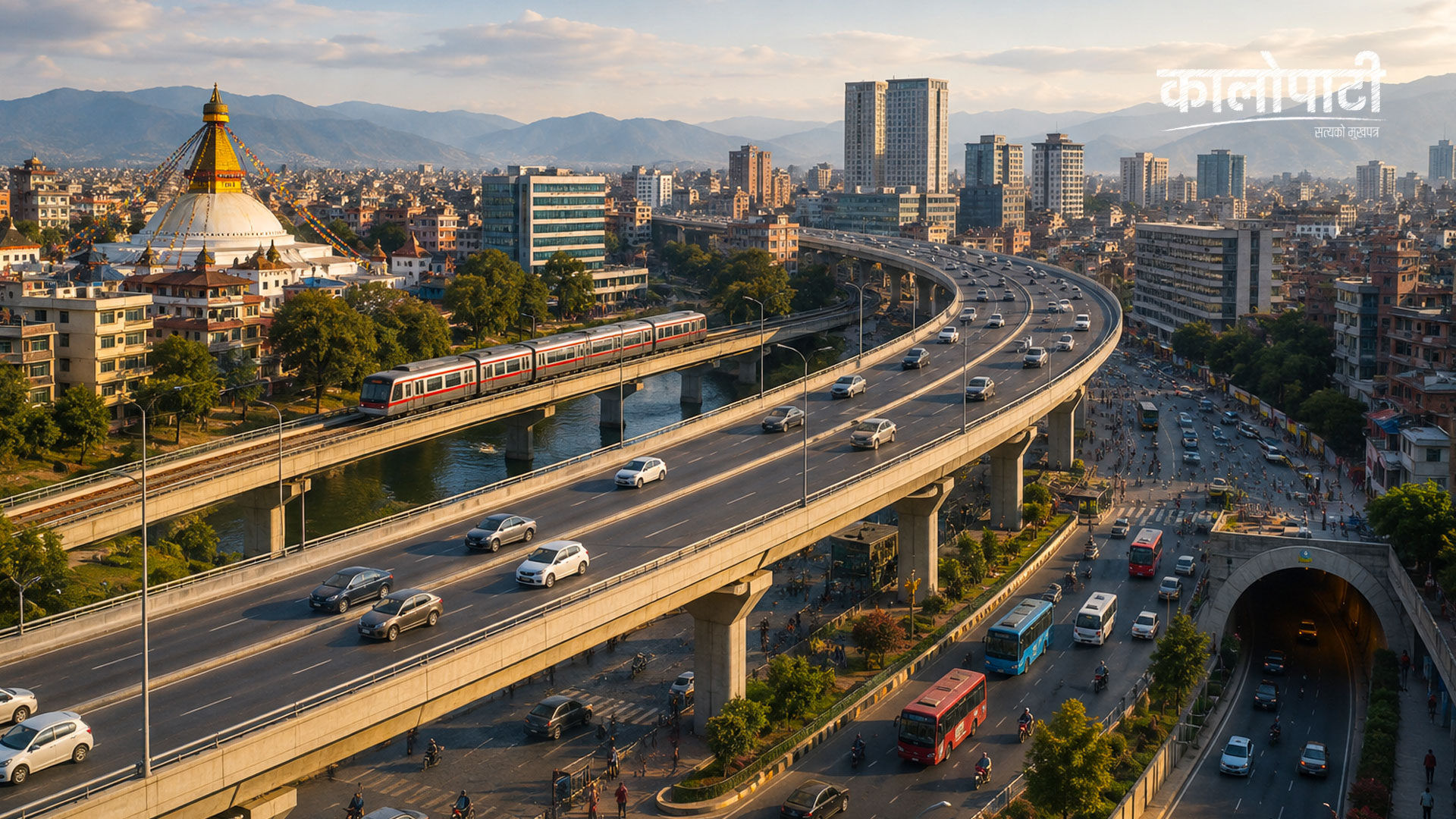
A total of 8.442 km long ({TAG_OPEN_span_203 TAG_CLOSE_span_203}}}’ ({TAG_CLOSE_span_201}}‘ has been proposed to be constructed in three major traffic congested areas of Kathmandu. Due to the lack of sufficient land for the expansion of the road and the compulsion to pay heavy compensation for the demolition of houses, the best option is to construct the road by raising pillars above the ground level. This technology will reduce the hassle of land acquisition along the road border. Since there are no intersections or traffic lights on such roads, vehicles will be able to move at high speed uninterrupted. It is estimated that around Rs 82 billion to Rs 111 billion will be spent to complete these three projects.
Maitighar-Tripureshwor: Heartburn Removal Sutra
A 1422-metre-long two-lane road has been proposed along the Maitighar-Thapathali-Tripureshwor section linking the administrative and commercial centres of the capital.TAG_OPEN_span_198 Around Rs 13.47 billion will be spent to solve the traffic jam in this section in the long term. Notably, TAG_OPEN_span_196 TAG_CLOSE_span_197 TAG_OPEN_span_197 TAG_CLOSE_span_198 it has also been suggested to study how the pillars of this road can be connected to the railway infrastructure that may be constructed in the future. This has the potential to make the same infrastructure multi-use.
Balance of Chabahil’s heritage and modernity
There is a plan to construct a 3400-metre-long elevated highway from Chabahil Chowk to Bagmati River, which will connect the northern region of Kathmandu at an estimated cost of Rs 25.TAG_CLOSE_span_195.}}, {{TAG_OPEN_span_193}.TAG_OPEN_span_195 Since this section includes Buddhist stupas in the World Heritage List, ‘ Heritage Impact Assessment‘ (HIA) } is mandatory before starting the construction. If the archaeological study does not give permission for the construction of a road here, then an alternative route should be found. This has created both challenges and opportunities to take development and heritage conservation together.
Bishnumati Corridor: The New Backbone of West Kathmandu
A 3620-metre-long four-lane elevated highway has been proposed in the Bishnumati River corridor to clear traffic jam in the west-south area of Kathmandu.TAG_OPEN_span_188 The road will be constructed along the river bank from Balaju to Tokha. Pillars will be erected at a distance of 20 meters from the river bank in view of the risk of floods. Three options have been given for this project to cost between Rs 43 billion and Rs 73 billion. It is expected to provide a big relief to the traffic congestion in the northern and western sections of the Ring Road.
Elevated Highway: What is and why is needed?
An elevated highway is a road built at a level above the ground level to reduce traffic congestion in urban areas. This is mainly a technology used to construct roads in areas where there is a shortage of land or in parks and forest areas. The biggest advantage of this is that thousands of houses do not have to be demolished for road expansion and the cost of compensation is saved. However, , } Its construction cost is much higher than that of normal roads, and its engineering, design and future maintenance are also very complex and expensive.
National Transport Policy 2083: The Beginning of a New Era
TAG_OPEN_span_184 After nearly 25 years, the government has revised the National Transport Policy ‘ National Transport Policy, {{TAG_OPEN_span_180}2083}‘ ‘ {{}}{{}. The policy aims to achieve sustainable and green transportation through an integrated transportation system that is sustainable , . According to Infrastructure Development Minister Sunil Lam TAG_OPEN_span_174 TAG_CLOSE_span_175 TAG_OPEN_span_175 TAG_CLOSE_span_176 sal, the transportation system will not be limited only to road construction but will focus on the expansion of digital systems and use of environment-friendly technology. The main focus of this policy is to make an effective network by coordinating the road{, }, }.
Strict laws for road safety and discipline
}
In order to prevent encroachment on the road and to regulate the movement of vehicles, the government has tabled the bill ‘ ‘{‘ }.TAG_OPEN_span_169 After the passage of this bill, the existing ‘ Public Roads Act, 2031‘ } will be repealed. The new law provides for severe penalties against those who encroach on the road , and damage the road. This bill can prove to be a milestone in protecting roads as public property and preventing rampant interference.
Fine up to Rs 10 lakh for road encroachment{
}
{{TAG_OPEN_span_156} The new bill prescribes a fine ranging from Rs 1,000 to Rs 10 lakh depending on the offense. The maximum penalty will be up to Rs 10 lakh for laying drainage, {}, pipe, } within the road limits without permission. Similarly, a fine of TAG_OPEN_span_150 TAG_CLOSE_span_151 TAG_OPEN_span_151 TAG_CLOSE_span_152 Rs 500,000 will be imposed on those constructing permanent structures within the road limits and Rs 500,000 for driving vehicles weighing more than the prescribed weight. A fine of Rs 5,000 will be imposed on those leaving pets on the road and up to Rs 100,000 will be imposed on those cutting trees on the roadside.
New Procedure and Judicial Powers
At least gazetted third class employees of the Road Office shall be deputed to investigate the offences relating to the road. The special feature of this bill is to give the designated officers of the road office the same powers as the district court. The officials of the concerned level will be able to directly punish the removal of obstructions and encroachments on the federal TAG_OPEN_span_147 TAG_CLOSE_span_148 TAG_OPEN_span_148 TAG_CLOSE_span_149 and provincial road networks. If the aggrieved party is not satisfied with such action, the aggrieved party can approach the district court within 35 days , }, which will speed up the legal process.
Unified Transport Authority and Powerful Structure
The TAG_CLOSE_span_144 government has decided to make the Urban Area Public Transport (Management) Authority {{TAG_OPEN_span_144 TAG_CLOSE_span_142}}‘ {TAG_OPEN_span_142 TAG_CLOSE_span_143 TAG_OPEN_span_143{TAG_OPEN_span_140}} more powerful in order to manage the public transport in the Kathmandu Valley. For this, a bill has been prepared to amend the Act of 2079. Now, the authority to determine the route of the vehicles in the valley , }, , } and to determine the fare shall be vested in the same authority. It aims to ensure passenger-friendly and systematic service by ending syndicates and chaos existing in route permits.
Night service and digital payments
{{TAG_OPEN_span_135} The proposed NEA bill will make the cashless (digital) fare payment system mandatory in the Kathmandu Valley. Passengers can pay the fare through a card or mobile app. In TAG_OPEN_span_133 TAG_CLOSE_span_134 TAG_OPEN_span_134 TAG_CLOSE_span_135 addition, the government will provide grants to the service providers who drive public vehicles at night or in special circumstances. As a result, employees and general public working late at night will be able to get vehicles easily. It will also be the responsibility of NEA to manage the bus park, , stops{, charging stations and traffic lights.
Development Tax: Sources of Financing for Infrastructure Construction
} The government is preparing to collect development tax from the landowners {{TAG_OPEN_span_127 TAG_OPEN_span_126 TAG_CLOSE_span_127}’{TAG_OPEN_span_125}}’ } as the value of the land in the area will increase after the construction of the new road. The new bill proposes to increase the tax rate from the current 20 percent to 25 percent. Such tax shall be levied for one time on land within a certain distance from the roadside. The government shall fix such tax by issuing a notice in the Gazette while giving compensation or increasing the value of land. This amount will be invested for road construction and maintenance.
Provision for auctioning land without paying tax
}
The government has made strict rules to strictly enforce the provision of development tax.TAG_OPEN_span_123 If any landowner fails to pay the development tax determined by the government within the stipulated time, action will be taken as if he or she has left the land revenue as per the prevailing law. The government may raise the amount by auctioning the concerned land to collect such tax. Although this is expected to contribute a large amount of money to the state exchequer for infrastructure development, it is certain to add financial burden to the landowners.
Classification and jurisdiction of three levels of road
The new TAG_OPEN_span_122 bill divides roads across the country into three tiers: federal, , provincial and local. The federal government will have expressways , national highways and roads of strategic importance. Other major roads in the province will be under the jurisdiction of provincial roads while the remaining rural and urban roads will come under the jurisdiction of local levels. Each level shall bear the full responsibility of construction, maintenance and maintenance of the roads falling under its jurisdiction , .
Road boundaries and physical infrastructure parameters
The new Road Act clearly specifies the right and left limits of the road (right of way) }. In the case of fast track, 50 meters of land on both sides of the road should be kept vacant. In the case of national and provincial roads, the limit of 25 meters has been fixed in the case of national and TAG_CLOSE_span_113}}, . Also, , }}’ structure construction limit{}’ {TAG_CLOSE_span_105}}, } will be 6 meters on federal roads, {} will be 3 meters in the provinces and 1.5 meters in local roads. This will reduce the problem of having to demolish houses again while expanding the road in the future.
Kathmandu Long Term Master Plan for 2050{{TAG_OPEN_b_216 TAG_CLOSE_b_216}}
A total of 2 TAG_OPEN_span_100 2 infrastructures and 13 transport improvement programs are proposed to make Kathmandu Valley’s transportation system world-class by 2050. This includes high capacity public transport from Ratnapark to Bhaktapur , ‘{TAG_OPEN_span_96}} mass transit{‘ } system{, There are ambitious projects such as the construction of underground tunnels in Maharajgunj and Chabahil-Gaushala sections.TAG_OPEN_span_92 The goal is to make the city people-friendly (people-centric) {{TAG_OPEN_span_90} by constructing car parking buildings and cycle lanes throughout the city in tourist places like Thamel and Durbar Square.
Terms of activation and implementation of JICA
}
Although the Japan Cooperation Agency (JICA) has been formulating the master plan of Kathmandu since 1991, its implementation has been weak.TAG_OPEN_span_89 Therefore, this time JICA has put strict conditions for getting the master plan approved directly by the cabinet. The government is scheduled to submit its report by August 2024. These billions of rupees worth of projects will materialize only with the technical support of foreign donors and the political will of the government.
Samagrama},
}
} This ‘ Rejuvenation‘ } is very promising. From the skyscraper road to the tunnel, the project seems to change the very face of Kathmandu. But TAG_OPEN_span_82 TAG_CLOSE_span_83 TAG_OPEN_span_83 TAG_CLOSE_span_84 the main question is the honesty of the management and implementation of the budget. The provisions of development tax and stiff fines may bring road discipline , , but they should not be a burden to the general public. If these master plans and legal reforms are successful, then , } In the next 25 years, Kathmandu will be known on the world map as a well-managed {, .
Leave your comment